Back
Product catalog
Technical work is underway. If you were unable to place an order, please contact us by phone.
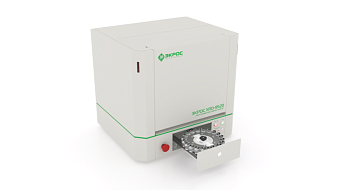
The X-ray fluorescence
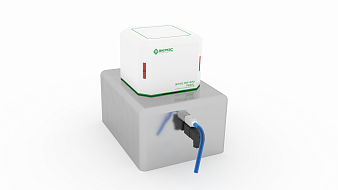
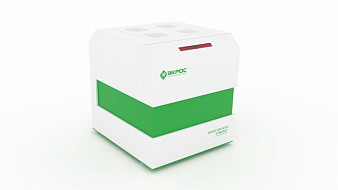
spectrometer EСROS TXRF-9730 MORAY is designed for express elemental analysis of solid and liquid samples
by X-ray fluorescence with total external reflection. Due to the features of
the X-ray optical scheme, detection limits reach tens of ppb.
Features:
∙
The range of
chemical element contents detection: from 10 ppb to 100%
∙
Liquid and solid
samples
∙
A small amount
of the analyzed sample is required
∙
Standard glass
slides can be used as a sample carrier
∙
Simultaneously
detected elements: from Na11 до Fm100
∙
Automatic
qualitative and quantitative analysis with graduation using samples with known
content
∙
Reference-free
quantitative analysis by the method of fundamental parameters without the use
of reference samples
Operation principle
The principle of operation of EСROS TXRF-9730 MORAY is based on the excitation of sample atoms and subsequent registration
of the X-ray fluorescence spectrum of the studied sample material. The energies
of the characteristic lines of the spectrum correspond to the chemical elements
contained in the sample, and their intensity is proportional to the
concentration of the corresponding elements.
A low-power end window X-ray tube is used as a source
of primary X-ray radiation. The primary radiation passes through a unique system
of collimation and monochromatization. When the sample is irradiated with X-ray
radiation, the atoms of the analyzed substance are excited, followed by their
emission of characteristic radiation.
The main feature of the instruments implementing the
method of X-ray fluorescence analysis with total external reflection is that
the X-ray beam falls on the sample at a small angle (below the critical angle
of total reflection of X-rays from the substrate), which leads to an almost
complete reflection of the exciting beam from the substrate without its
excitation. In addition, interference of exciting radiation occurs in the
analysis area, which leads to greater excitation of the atoms of the sample
material. As a result, the signal-to-noise ratio increases and detection
limits decrease.
Secondary fluorescent radiation from the sample is
detected by a silicon drift detector with Peltier element cooling and a carbon
input window, the signal from which is processed by an electronic circuit and
converted into a spectrum.
The substrate with the sample applied on it is automatically installed
using a sample sensor. The X-ray tube and detector are located above the
sample, which eliminates the possibility of contamination of the X-ray tube and
detector.
Technical specifications:
Range of defined elements: Na11 до Fm100
X-ray tube: 12 W (end window), Rh (Mo, Ag) anode
SDD detector with electric cooling, resolution <
127 eV, carbon window, sensitive area size 20 mm2 (optional up to 50 mm2)
Unique primary radiation collimation system
Air cooling
Overall dimensions (W*H*D): 290*340*410 mm
Weight: 10 kg
The instrument completeness
The basic set includes:
∙ EСROS TXRF-9730 MORAY (analytical unit)
∙ laptop or desktop computer with installed software
for working with the spectrometer
∙ a set of spare parts and accessories
Additional options:
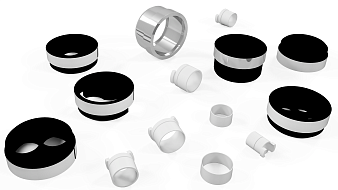
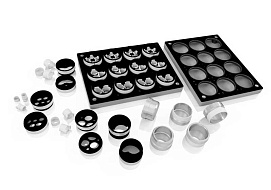
∙ additional slides (including sapphire ones)
∙ stirrer
∙ set of micropipettes
∙ printer
∙ solution of the internal reference material